Background
Biodegradable packaging breaks down with naturally occurring microbes, but that process can take years in a regular landfill. Compostable packaging is a much stricter subset: it has to break down completely in an industrial compost pile in under 6 months, leave no toxic bits behind, and not mess up the soil’s ability to grow plants.
The EU’s Single-Use Plastics Directive didn’t just ban certain single-use items. It made it illegal to label anything “compostable” in the EU without third-party proof. The US FTC updated its Green Guides in 2024, and now you can get fined up to $50,120 per mislabeled product unit if you claim something is biodegradable when it won’t break down in a normal landfill within a year. Even markets like Singapore and Australia now won’t let big supermarket chains stock eco friendly food packaging supplier products unless they have valid, up-to-date certification paperwork.
Core Must-Have Certifications No Serious Buyer Skips
You don’t need 12 different logos on your product to sell it well, but there are four non-negotiable categories of certifications that every cross-border B2B buyer should check before signing a purchase order.
First up is food contact safety. If you’re selling disposable tableware that touches hot soup or greasy fried chicken, EU 10/2011 is the rule you can’t skip for Europe. It says no heavy metals or weird organic chemicals can leach out of the material into your food. For the US market, FDA 21 CFR Part 176.170 is the standard, and for PLA cups specifically, the lactic acid migration can’t go over 10mg per square decimeter.
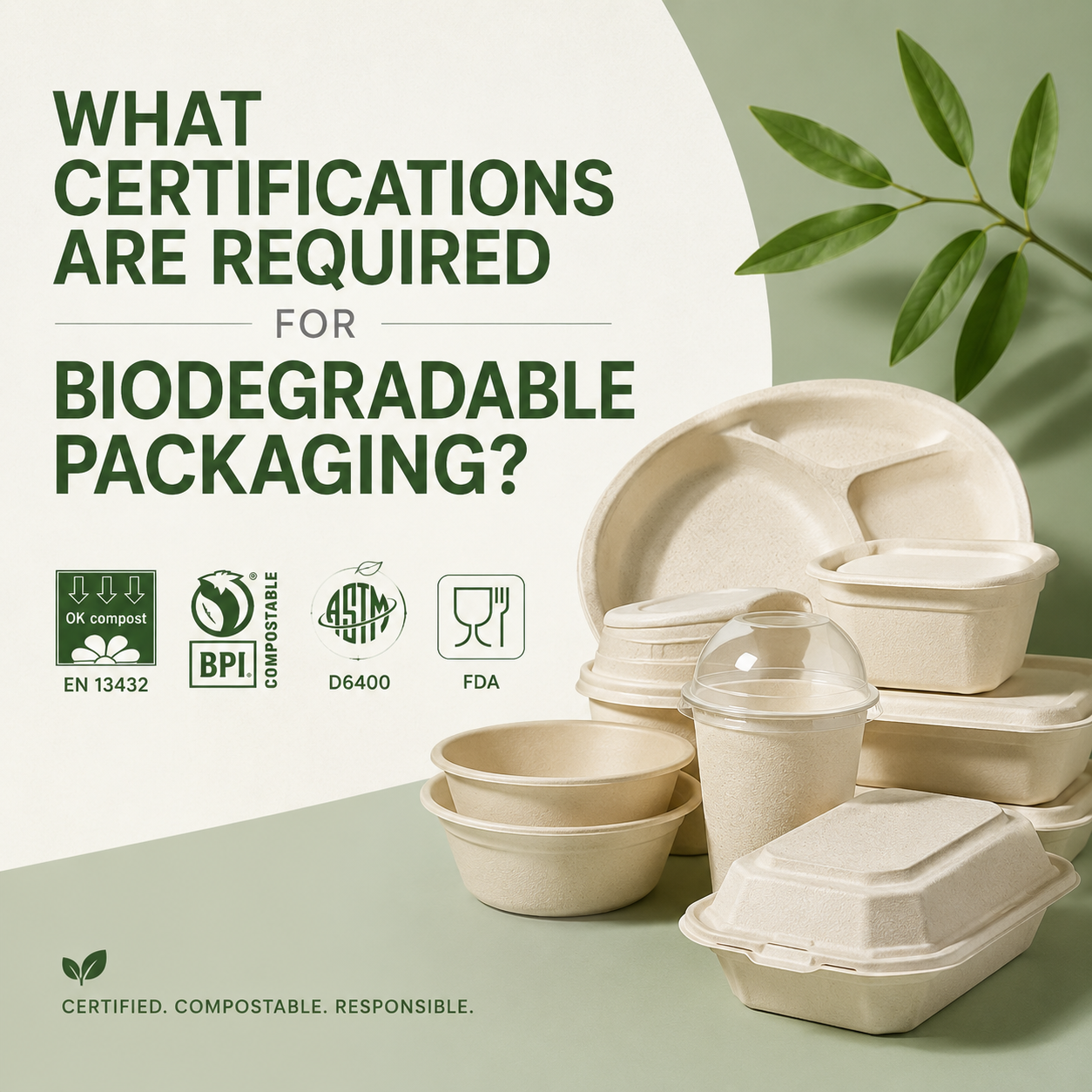
Then there’s the big two for biodegradation: EN 13432 for Europe and ASTM D6400 for North America. EN 13432 says 90% of the material has to turn into CO2 and biomass in 180 days in a 60°C industrial compost pile. ASTM D6400 adds an extra check to make sure it doesn’t leave tiny visible bits behind after 84 days. These two standards are accepted in 40+ countries, covering almost 80% of the global wholesale food packaging market.
This quick reference table is what I send to all my new procurement contacts to keep their sourcing team from mixing up different certifications:
| Certification | Issuing Body | Hard Rule You Actually Care About | Main Market |
| EN 13432 | European Committee for Standardization | 90% biodegrades in 180 days (industrial compost) | EU, UK, UAE |
| ASTM D6400 | ASTM International | 90% biodegrades in 180 days, no visible leftover bits | USA, Canada, Australia |
| BPI Compostable | Biodegradable Products Institute | Full ASTM D6400 compliance + annual factory audit | US national grocery chains |
| OK Compost Home | TÜV AUSTRIA | 90% biodegrades in 365 days at regular home compost temps | EU independent cafes and bakeries |
| FDA 21 CFR Part 176.170 | U.S. FDA | Food contact chemical migration under 10mg/dm² | US food service distributors |
| SUPD Compliance | European Commission | No “oxo-degradable” plastic allowed in the product | All 27 EU member states |
Real Industry Data No Supplier Will Tell You
Last year, a third-party lab in Germany tested 200 different “biodegradable” disposable tableware samples from 12 different countries. 38% of them had 15% or more hidden regular PP plastic mixed in, and those samples still hadn’t broken down after 2 full years in a compost test. That’s why big clients like McDonald’s Europe don’t just ask for a one-time certification. They ask for batch-specific test reports for every single shipment of compostable food containers.
For bagasse tableware that’s properly certified, it can handle 120°C heat for 30 minutes in a microwave without warping. But the cheap uncertified stuff? I’ve seen it start to bend and leak when you put 90°C coffee in it. For clear PLA cups, the good certified ones don’t crack until you get down to -5°C, but the low-quality ones will split if you leave them in a freezer overnight for 2 hours.
Practical Procurement Tips That Actually Save You Money
- First, never just take a PDF of a certification from a supplier at face value. Go to the TÜV or BPI official website, type in the certificate number, and check if it’s still valid. I’ve seen so many buyers get burned by 3-year expired certificates that the supplier never bothered to renew.
- Second, pick your certifications based on who your end customer is, not just what’s cheapest. If you’re selling to small cafes in the Netherlands, getting OK Compost Home will let you charge 15-20% more than competitors who only have basic EN 13432. If you’re working with Walmart in the US, skip every supplier that doesn’t have BPI certification. They won’t even let you step into a meeting without it.
- Third, run away from any supplier that offers a “custom internal biodegradable certificate” for 10% off the unit price. Those pieces of paper mean nothing at customs, and I’ve seen a $120,000 shipment get seized in Los Angeles because the buyer trusted one. The fines and disposal fees ended up costing them 4 times what the order was worth.
FAQ That Actual Procurement Managers Search Every Week
Q: I have ASTM D6400, can I skip EN 13432 and ship to Germany?
A: No. German customs will hold your shipment. ASTM D6400 is similar, but the EU SUPD law explicitly requires EN 13432 documentation for all compostable food packaging sold in the region. You’ll get hit with storage fees every day it sits at the port.
Q: What’s the real difference between industrial compostable and home compostable?
A: Industrial compost facilities run at 58-70°C 24/7, so materials break down fast. Home compost piles usually sit around 20-30°C, and most industrial compostable products won’t break down there for years. OK Compost Home is the only widely accepted proof that your product will actually break down in a regular backyard bin.
Q: If I get custom disposable food packaging printed, do I need new certifications for the ink?
A: 100% yes. I watched a 500,000 unit order of custom printed salad bowls fail their EN 13432 test last year because the supplier used cheap uncertified ink. The ink left toxic residues that made the whole batch fail the ecotoxicity check, and they had to throw every single bowl away.
Why Hydebiopack Works For B2B Buyers
As a compostable food containers manufacturer that’s been making disposable tableware for 8 years, we don’t cut corners on certifications. Every single product line — from bagasse plates to PLA cold cups — has full, in-date EN 13432, ASTM D6400, BPI and FDA paperwork, and we give you batch-specific test reports with every order, no extra charge.
We offer Custom Size Available for all our standard SKUs, and Custom Printing Available with 100% compostable food-grade water-based ink that already has all the required biodegradation certifications. We also run full OEM & ODM Service, and can turn your custom brand packaging idea into a finished sample in 7 days.
Final Word
Biodegradable packaging certifications aren’t a red tape hassle. They’re the only thing that keeps you from wasting money on bad shipments, losing big retail clients, and getting stuck with fines you never saw coming. When you pick a supplier that doesn’t treat certifications as an afterthought, you build a supply chain that doesn’t just meet rules — it lets you sell to every major market in the world without constant headaches.