
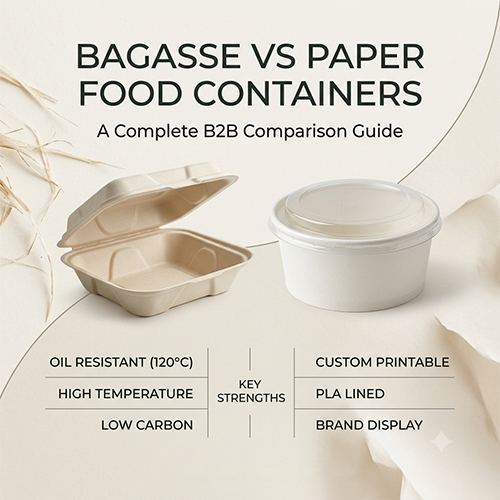
As foodservice chains, event caterers and eco friendly food packaging suppliers across every major market move steadily away from petroleum-based single-use plastics, two plant-derived packaging solutions have taken the lead in real-world adoption: molded sugarcane bagasse food containers, and food-safe paper food containers with or without food-grade PLA lining. 2025 industry tracking from the Global Sustainable Packaging Alliance shows the worldwide plant-based food service packaging segment expanded 17.9% year-over-year, with bagasse and paper variants together making up nearly 63% of all non-plastic disposable tableware units shipped. For multi-location restaurant groups, contract catering operators, and bulk wholesale food packaging purchasers, this choice is never a one-size-fits-all “winner takes all” call — it hinges on your daily operational workflows, core menu makeup, and local municipal organic waste processing capacity.
Core Performance Breakdown
Bagasse is the dry, fibrous leftover material generated after sugarcane stalks are crushed to extract juice for sugar production. Unlike many fiber-based packaging options, its manufacturing workflow does not require felling any timber, which makes it a natural fit for brands targeting verified low-carbon operational targets. Its naturally interwoven fiber structure delivers exceptional structural sturdiness and high temperature tolerance, making it perfectly suited for piping hot takeout orders, oil-heavy fried menu items, and high-traffic self-service buffet lines. Paper food containers, by comparison, support far more precise, high-resolution surface printing, which makes them the go-to selection for brands that need to showcase detailed brand artwork, seasonal promotion visuals, and custom disposable food packaging that stands out in customer social media posts.
Core Analysis
To help B2B buyers make informed decisions, we have organized a side-by-side comparison of key performance metrics for both materials, based on third-party lab testing from the European Bioplastics Association:
| Performance Metric | Sugarcane Bagasse Food Containers | Paper Food Containers |
| Average Compost Time (Industrial) | 30–45 days | 45–60 days |
| Oil Resistance Temperature | Up to 120°C | Up to 110°C |
| Water Holding Time (Cold Liquid) | 6+ hours | 4+ hours |
| Average Stacking Strength (100 units) | No deformation under 18kg load | No deformation under 12kg load |
| Carbon Footprint Per Unit | 0.023 kg CO₂e | 0.037 kg CO₂e |
| Freezer Safe | Down to -18°C | Down to -10°C |
Industry Standards & Verified Data
Both product families must meet strict international regulatory benchmarks to access mainstream retail and foodservice supply chains. The European Union’s Single-Use Plastics Directive 2019/904 classifies fully uncoated compostable bagasse and plain unlined paper products as exempt from plastic packaging bans, provided they pass all test criteria laid out in the EN 13432 industrial compostability standard. For the North American market, the U.S. FDA 21 CFR Part 176.170 regulation establishes strict, measurable limits on substance migration for both sugarcane fiber and food-grade paper board, eliminating risks of unintended chemical transfer into high-heat or high-fat prepared foods.
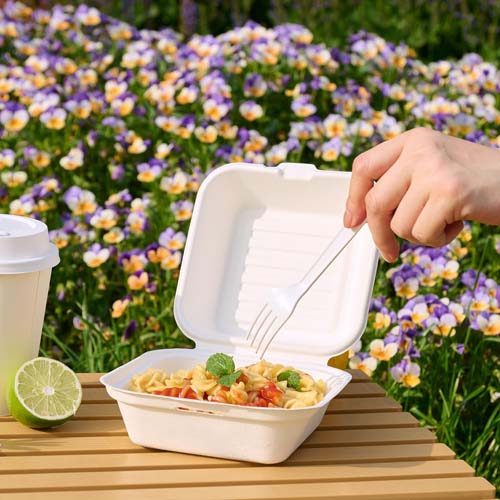
Field data from 2024 catering case studies shows that for large-scale event catering serving over 5,000 guests per day, switching to bagasse clamshells can reduce container leakage complaints by 37% compared to regular paper containers. For coffee shop chains that prioritize brand display, custom printed paper food containers can increase social media sharing rates of takeout orders by an average of 22%, according to a survey by the Specialty Coffee Association.
Practical Procurement Advice
For global wholesale food packaging buyers, we recommend a tiered selection strategy based on your core business scenarios:
- If your menu focuses on hot soups, curries, deep-fried snacks or frozen pre-packaged meals, prioritize sugarcane bagasse food containers to reduce leakage and deformation risks during delivery.
- If your brand relies heavily on unboxing experiences, seasonal promotional packaging or high-resolution graphic displays, PLA-coated paper food containers will offer better printing results and brand presentation.
- For mixed business scenarios, many leading compostable food containers manufacturers recommend a hybrid stock strategy: keep 60% of inventory in bagasse for high-traffic hot food services, and reserve 40% of SKUs for custom printed paper containers for signature menu items and marketing activities.
FAQ
- Can both bagasse and paper food containers be disposed of in home compost bins?
Uncoated bagasse products break down in 90–120 days in typical home compost conditions, while most PLA-coated paper containers require industrial compost facilities with consistent 60°C+ temperatures to fully decompose. We recommend checking local municipal compost rules before selecting materials for regional distribution. - Are bagasse food containers more expensive than paper options in bulk orders?
As of 2026, standard-size bagasse clamshells are priced 8–12% higher than equivalent weight paper containers in spot markets, but large bulk wholesale supply contracts can narrow this gap to 3–5% when ordered directly from a compostable food containers manufacturer. - Can I get custom sizes for both material types?
Yes, both materials support non-standard dimensions, but bagasse custom mold development usually requires a 2–3 week lead time, while custom paper food packaging can be produced with existing die-cut tools for faster turnaround.
Custom Manufacturing Capabilities
We support flexible customization solutions for global B2B buyers, including custom size, custom printing, low MOQ support, and full OEM & ODM service for bagasse food container lines. With mature bulk wholesale supply chains covering North America, Europe and Southeast Asia, we can match your material selection to your specific menu, brand and logistics requirements, no matter if you run a small coffee shop chain or a large international catering group.