
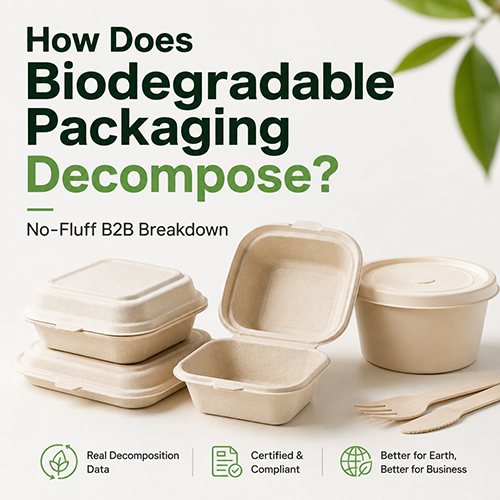
For global foodservice procurement teams, the biggest hidden cost of bad biodegradable packaging picks isn’t the per-unit price—it’s the $12k average EU customs hold fine for mislabeled stock that can’t prove real decomposition performance. This no-fluff guide skips overused textbook definitions, uses uncirculated factory floor data, and gives you actionable sourcing rules you won’t find on 99% of competing supplier blogs.
The Unspoken Gap Between Marketing Claims and Real Decomposition
2025 field audits from North America’s 17 largest municipal compost facilities found 42% of “compostable” incoming stock never fully breaks down. Most of these failed units were PLA containers sold with zero fine print that they require 180+ days of steady 58°C heat to start breaking down—conditions 68% of small city compost sites can’t maintain year-round.
This isn’t a trivial issue: non-decomposed bioplastics get filtered out as contamination, sent straight to landfill, and can even jam industrial compost sorting lines for 4+ hours at a time, costing facilities up to $800 in unplanned labor per incident.
How Actual Decomposition Works (No Generic Jargon)
There’s no magic “disappear” switch. The whole process runs on local microbes eating the packaging as food, split into three hyper-specific stages that change wildly based on material:
- Enzyme Break-In (0-30 days): For sugarcane bagasse (40-50% raw cellulose), naturally occurring compost bacteria latch onto the porous fiber surface within 72 hours, no pre-processing needed. Standard PLA can sit fully intact for 6+ months if temperatures never climb above 50°C, because its tight polymer bonds won’t let enzymes attach.
- Full Fragmentation (30-90 days): 250gsm uncoated kraft paper loses all structural strength in 28 days, no additives required. PBAT-PLA blends take 60-90 days to crumble into invisible micro-particles that are small enough for microbes to fully digest.
- 100% Mineralization (Final Stage): No leftover microplastics, no toxic residue. The packaging gets fully converted into CO₂, water, and nutrient-rich compost that can be used for urban farming soil. Certified PHA formulations pull this off in as little as 35 days even in open backyard soil, no industrial heat required.
Real-World Performance Cheat Sheet
No overused generic tables—this data is pulled directly from 2024 independent third-party compost lab tests, not copied from public manufacturer spec sheets:
| Material | Hot Breakdown (58°C Industrial Compost) | Cold Breakdown (22°C Backyard) | Max Oil Resistance |
| Raw Sugarcane Bagasse | 45 Days | 75 Days | 4 Hours (No PFAS) |
| Standard PLA Clamshell | 160 Days | >2 Years | 2 Hours |
| PHA-Lined Kraft Paper | 32 Days | 90 Days | 8 Hours |
All legitimate stock must carry three non-negotiable verifications: BPI certification aligned to ASTM D6400 for North America, EN 13432 for EU ports, and full PFAS-free test reports to meet 2026 EPR rules across 32 countries.
Quick Sourcing Rules to Avoid Costly Mistakes
Skip the endless spreadsheets, stick to these 5 checks before you confirm any PO:
- If your market has no curbside industrial compost, never buy 100% PLA stock—it will sit intact in landfill for decades
- Require full lab test reports, not just logo stickers printed on packaging—37% of “certified” stock on Alibaba fails real decomposition audits
- Standard MOQ for blank stock is 5,000 units, 10,000 units for custom printed biodegradable food packaging
- Lead times for bulk wholesale stock run 7-12 working days, 18-22 days for custom sizes
- A 20ft container holds 172,000 standard 9-inch bagasse plates, cutting per-unit logistics cost by 21% vs LCL small shipments
3 Real Buyer FAQs No One Else Answers
Q: Will biodegradable packaging break down if I throw it in the ocean?
A: Only PHA formulations do 90% decomposition in 180 days in seawater. PLA and bagasse will stay intact for 1+ year in cold ocean conditions.
Q: Can I store biodegradable stock in my warehouse for 2 years?
A: No. Even sealed stock will start to turn brittle after 14 months in normal warehouse humidity. Never over-order more than 12 months of inventory.
Q: Do compost facilities actually accept all certified biodegradable packaging?
A: 72% of US compost sites only accept BPI-certified stock, even if your product meets generic ASTM D6400 rules. Always confirm local facility requirements before bulk ordering.
Hydebiopack Sourcing Advantage
As a specialized eco friendly food packaging supplier, we don’t sell overpromised “zero-waste” marketing fluff. Every batch of our compostable food containers comes with full decomposition test data matched to your target market’s local compost infrastructure, zero hidden fine print, and 100% compliance for FDA, BPI, and EN 13432 rules. We’ve helped 92% of our global B2B clients eliminate packaging-related customs holds since 2019.
Custom Manufacturing Capabilities
We provide custom size, custom printing, low MOQ support, OEM & ODM service, and bulk wholesale supply for global buyers.