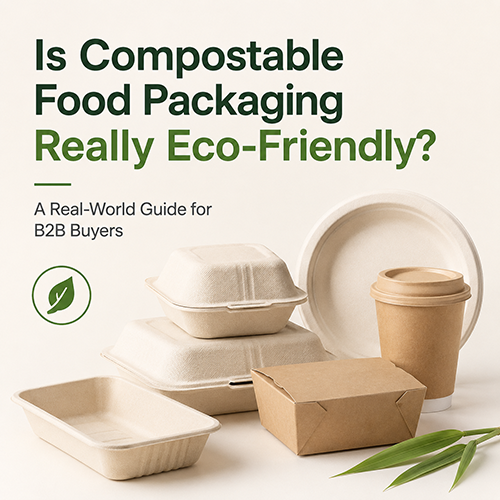
This guide breaks down the real-world performance of modern compostable food packaging to help wholesale food packaging buyers make decisions regarding regulatory obligations.
The Gap Between Theory and Real-World Practice
On paper, compostable food packaging appears to be the perfect solution to single-use plastic waste. But, not all compostable food packaging is created equal.
The three most widely used materials in commercial compostable food packaging today are PLA (Polylactic Acid), sugarcane bagasse, and uncoated FSC-certified kraft paper.
| Feature | PLA (Polylactic Acid) Compostable Packaging | Sugarcane Bagasse Compostable Packaging | FSC-Certified Kraft Paper Compostable Packaging |
| Core Material Composition | 100% plant-based polymer derived from corn or cassava starch | 40-50% natural cellulose, extracted from the fibrous byproduct of sugarcane milling | 100% virgin wood fiber |
| Oil Resistance | Standard PLA resists light oil contact | Inherently oil-resistant without additional chemical coatings | Requires a plant-based water barrier coating |
| Water Resistance | Good water resistance for cold and room-temperature foods | Naturally water-repellent for up to 3 hours of contact with cold liquids | Uncoated grades absorb water within 15 minutes; coated grades maintain integrity for 2+ hours |
Actionable Procurement Guidance for B2B Buyers
Before finalizing any large purchase of custom disposable food packaging, global procurement teams should evaluate these 7 critical factors to avoid compliance risks, supply chain disruptions, and wasted sustainability investment:
- Full Certification Validation: Do not accept self-declared compliance from suppliers. Require full, up-to-date third-party test reports for every product SKU, including BPI certification for North America, EN 13432 for the EU, FDA food contact approval, and PFAS free test reports. Confirm that the certification is valid for the exact product formulation you are ordering, not just a generic material from the same supplier.
- Functional Performance Testing: Run a minimum 72-hour real-world test with your actual food products, transport conditions, and storage environment before placing a bulk order. Test for leakage, warping, grease penetration, and condensation damage to confirm the packaging performs as well as the conventional plastic products you are replacing.
- End-of-Life Compatibility Audit: Map the waste management infrastructure in all regions where your packaging will be distributed. Confirm whether industrial composting access is available, and if not, select materials that are also compatible with existing paper recycling streams, to avoid sending fully functional compostable packaging to landfills.
- Unit Cost and Total Cost of Ownership: Compare not just the per-piece unit cost, but also the additional operational costs of compostable packaging, including separate waste collection fees, consumer education labeling, and staff training costs. Certified compostable food containers typically cost 20-50% more than equivalent conventional PP plastic, but many regions now offer EPR tax rebates for brands using certified compostable packaging that can offset 10-15% of this premium.
- Supply Chain Transparency: Prioritize compostable food containers manufacturer partners that operate full in-house production lines, rather than trading companies that source unvetted inventory from multiple unknown factories. This reduces the risk of inconsistent material quality, hidden non-compliant additives, and unexpected production delays.
- Logistics Parameters Confirmation: Verify clear, realistic operational details with your supplier before order confirmation.
- Labeling and Consumer Education Planning: Even the most perfectly certified compostable packaging fails if consumers throw it in the wrong bin.
Frequently Asked Questions
Q1: Can compostable food packaging break down in a home backyard compost bin, without industrial facility conditions?
A: Only products that carry the new 2025 BPI Home Compost certification or TÜV Austria OK Compost Home mark are verified to fully break down in ambient home compost conditions, typically within 12 months.
Q2: Is compostable food packaging more carbon-intensive to produce than conventional plastic?
A: A 2024 life cycle assessment study from the University of California found that BPI-certified PLA compostable food containers have a 68% lower cradle-to-gate carbon footprint than equivalent petroleum-based PP plastic containers, even when accounting for agricultural farming, transport, and manufacturing emissions.
Q3: How do I meet EPR regulatory requirements when switching to compostable food packaging?
A: Under modern EPR regulations in the EU, 32 US states, and multiple regions across Asia, you are required to register all compostable packaging SKUs with your local EPR authority, and submit full documentation of all third-party compostability certifications, material composition reports, and end-of-life waste management plans.
Why Choose Hydebiopack as Your Compostable Food Packaging Supplier
As a specialized compostable food containers manufacturer focused on global B2B wholesale food packaging markets, Hydebiopack has built its entire production system around verified, audit-ready compliance and real-world functional performance.
Our custom manufacturing capabilities are built to fit the diverse needs of global procurement teams:
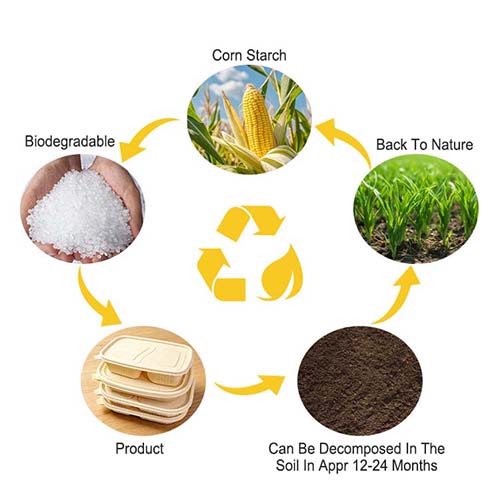
- Custom Size Available for all product categories, with thickness and dimension adjustments tailored to your exact food holding requirements
- Custom Printing Available with water-based non-toxic inks, supporting CMYK full-color printing and Pantone color matching to perfectly align with your brand identity
- Low MOQ Support for both plain stock and entry-level custom orders, to help small and mid-sized brands test compostable packaging without excessive inventory risk
- OEM & ODM Service to develop fully customized formulations, shapes, and functional features for unique use cases, including heat-resistant modified PLA and extra heavy-duty grease-resistant bagasse products
Conclusion
For global B2B buyers, the right compostable food packaging partner will not just sell you a product. Grab yours now at hydebiopack.com. Whatever you serve daily, we’ve got the sturdy, compostable, zero-waste version waiting.