
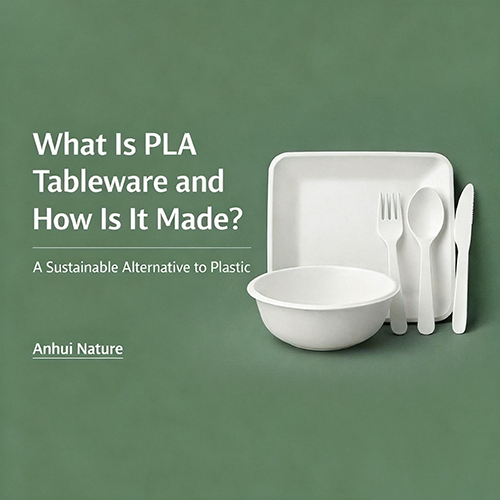
PLA Tableware: An Everyday Sustainable Option
Imagine picking up a lightweight fork or bowl at a street food stall or neighborhood eatery—it holds steady, feels natural, yet stems from something grown in fields rather than drilled from the ground. PLA tableware captures this idea perfectly.
Polylactic acid, known simply as PLA, comes from fermenting starches pulled from crops like maize or cane sugar plants.
Key Benefits That Make PLA Tableware Appealing
These items manage routine tasks reliably, holding shape for icy beverages or slightly heated meals without sudden bending. The true edge shows in disposal: at dedicated compost plants using warmth and bacteria, it reverts to simple stuff like H2O and carbon dioxide over just a few months, dodging the endless stay of typical throwaways.
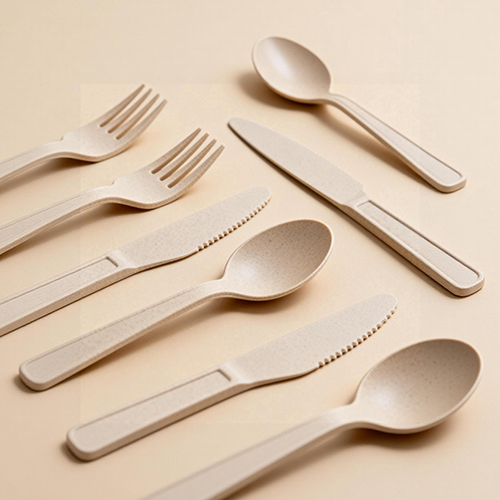
Step-by-Step Journey: Turning Plants into Usable Tableware
It kicks off across vast fields as crops mature under the sun. After collection, raw materials move to prep sites for breakdown.
Milling plus steeping isolates the key starch from leftover plant bits. With enzyme treatments and mild heating, starch shifts to basic sweeteners—often dextrose type.
Then microbes dominate huge tanks, eating up sugars to spit out lactic acid. Like age-old cheese or ale making but amped for accuracy and cleanness. Post deep cleansing to ditch junk, the acid awaits action.
For polymer assembly, lactic acid shifts to lactide loops through vacuum drying. Those loops split and connect via catalysts and even temps, weaving into lengthy PLA fibers.
The material solidifies and gets chopped into convenient resin beads.
Those beads move to fabrication lines. They melt under heat, and machines inject the flow into custom dies for detailed shapes—like tined utensils or contoured dishes—or use pressure forming for broader pieces. Rapid chilling hardens everything in place. Workers trim any flash, run visual and strength tests to catch flaws, and ensure the batch meets hygiene standards. Out comes PLA tableware, fully plant-sourced and set for service.
How PLA Tableware Stacks Up Against Conventional Plastic Versions
Compare PLA tableware directly with standard plastic counterparts, and the gaps show up fast. Oil-based versions come cheap, endure broad heat swings, and rarely complain under stress. They dominate where extreme conditions rule.
On the flip side, they refuse to vanish, lingering as fragments that infiltrate waterways and wildlife for hundreds of years. PLA tableware delivers solid performance for typical cold-through-tepid applications and vanishes cleanly in managed compost without leaving poisons behind.
Sourcing from fields pushes the starting price above petroleum routes due to farming and conversion needs, yet the eco-narrative and future-proofing often justify it for forward-looking groups. Thermal limits differ—basic PLA yields around hotter loads, though fortified types extend the range. When cutting overall ecological strain ranks high, PLA tableware edges forward as the wiser long-game selection.
Bringing PLA Tableware Into Your Routine
Anhui Nature emphasizes adaptability with PLA tableware. We manage standard volumes alongside bespoke runs: altered dimensions, preferred shades, surface textures, or custom counts.
Curious about possibilities or want pricing details? Get in touch with our team—we’ll guide you through creating custom PLA tableware that aligns with your setup and advances real environmental progress.