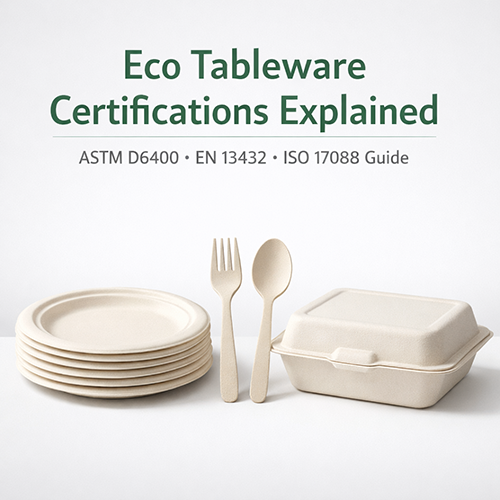
Those little certification icons on biodegradable tableware packs—ASTM D6400, EN 13432, ISO 17088—look impressive, but what do they actually tell you about your compostable plates or cutlery? They’re not random stamps. Each one comes from serious lab work showing the item can vanish safely in big commercial composting setups, turning into good soil instead of garbage.
The Point of Getting Certified (Beyond Marketing)
Lots of disposable eco tableware gets sold with vague “biodegradable” wording, but without proof it often just shreds into micro-plastics that hang around forever. These certifications run the material through simulated industrial compost tests—warm, wet, full of active bugs—to make sure it:
- Mostly disappears chemically (90% or more into CO₂, H₂O, and new organic stuff).
- Physically crumbles quickly (no big chunks left after a few months).
- Doesn’t poison the final compost—plants grow fine in it.
- Contains almost zero heavy metals or bad chemicals.
That way, your sustainable forks and bowls actually support closed-loop systems at real facilities, not just sound nice on the label.
ASTM D6400: North America’s Main Compass
For the US and Canada, ASTM D6400 sets the bar for calling plastics compostable in municipal or commercial piles. It checks if biodegradable plates and spoons can:
- Reach 90% breakdown (measured as CO₂ release) in up to 180 days at composting temps.
- Break into bits where over 90% slips through a 2 mm screen after roughly 12 weeks.
- Leave behind compost that lets seeds sprout and grow normally—no signs of harm.
- Keep restricted metals way below safe thresholds.
The BPI mark usually rides along because they certify using this exact spec. If you’re running events or supplying in North America, this one typically means the product gets accepted at local composting spots without hassle.
EN 13432: Europe’s Packaging Must-Have
The EU ties packaging rules tightly to EN 13432, so it’s the key for anything headed there—including compostable cutlery and disposable plates. It demands similar results to the American one but adds some sharper edges:
- 90%+ biodegradation in six months.
- Disintegration leaving less than 10% original dry weight after 12 weeks.
- Strong proof the compost stays healthy: plant growth tests are mandatory, and earthworm checks sometimes join in.
- Stricter limits on certain contaminants.
Look for TÜV Austria’s “OK Compost INDUSTRIAL” or equivalent badges. For European sales or exports, skipping this often means your shipment gets bounced or fines hit.
ISO 17088: The Global Connector
ISO 17088 is the international spec from the big standards body, designed to line up compostable plastics no matter the country. It hits the same high notes—strong breakdown, fast fragmentation, safe end compost, low hazards—but keeps things flexible so different regions can accept it as equivalent.
This one’s super useful for brands going multi-continent: nail ISO 17088, and your eco-friendly tableware frequently qualifies for both ASTM and EN marks too, cutting down on extra testing.
Breaking It Down Side by Side
These all aim at industrial composting (hot, managed facilities—not your backyard bin), with overlapping demands but a few regional flavors:
- Where they rule — ASTM D6400 dominates North America, EN 13432 controls Europe, ISO 17088 bridges everywhere.
- Key tweaks — Europe (EN 13432) insists harder on ecotoxicity and packaging details; ASTM covers wider plastic types; ISO stays neutral and harmonized.
- Practical upside — Many quality compostable tableware ranges now pass versions of all three, letting one batch serve different markets easily.

Hydebiopack.com carefully sources and checks our biodegradable plates, compostable bowls, knives, forks, and spoons to fit the right combo for your area and needs.